Tell us about the job
Takes about a minute. No obligation.
Homes in Newberry County, SC run heat about five months a year, from November through March. The burner and heat exchanger cycle through that full stretch every year, and a contractor working a furnace repair here checks them first. Crack formation in a heat exchanger, carbon buildup on a burner port, and wear on the ignition assembly all trace back to accumulated firing cycles, not to a single failure event. A contractor who skips that inspection and quotes a control board swap may fix the symptom while the underlying condition keeps working.
Furnaces in houses this old have usually been replaced at least once, and what sits in the closet or utility room now is not the original equipment. That matters for repair because once a contractor opens the unit, the question is whether the failed part is still in production. Half the homes in Newberry County, South Carolina were built in 1981 or earlier (2020-2024 ACS 5-year). Stock with that kind of history has often landed on a furnace that is itself well past its early years, and replacement components for older heat exchangers and burner assemblies are not always available through standard channels. A contractor who can source the part gets the repair done; one who cannot is quoting a replacement conversation instead.
The Parts of a Furnace a Contractor Checks First
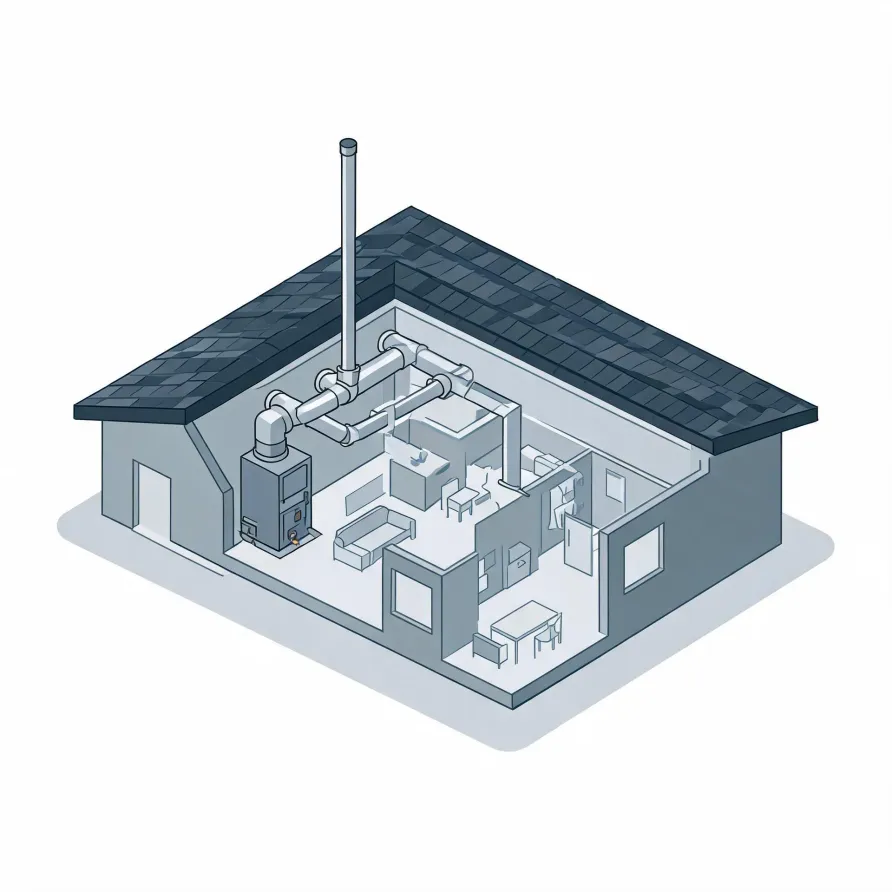
The furnace itself sits in a utility space, basement, or closet and is the piece doing the heating work. Inside it, the heat exchanger and burner assembly are where a contractor starts when something is wrong. A cracked heat exchanger, a failed igniter, or a dirty burner shows up in how the unit fires, how it runs, or whether it runs at all.
The blower motor pulls air through the unit and pushes it toward the rest of the house. The flue or exhaust vent runs from the furnace to an exterior wall or roofline and carries combustion gases out. The filter sits at the air intake side and, when clogged, puts strain on the blower before anything else shows signs of trouble.
The drawing shows a typical furnace layout, and a licensed contractor determines what applies to this particular house.
Get matched in Newberry CountyNewberry County, by the numbers
231 severe weather events were recorded in Newberry County, South Carolina between 2015 and 2024.
NOAA National Centers for Environmental Information, Storm Events Database, bulk CSV export, events 2015-01-01 through 2024-12-31.Half the homes in Newberry County, South Carolina were built in 1981 or earlier (2020-2024 ACS 5-year).
U.S. Census Bureau, 2020-2024 American Community Survey 5-Year EstimatesNewberry County, South Carolina holds 18,558 housing units (2020-2024 ACS 5-year).
U.S. Census Bureau, 2020-2024 American Community Survey 5-Year EstimatesOwners occupy 73.1% of the occupied homes in Newberry County, South Carolina (2020-2024 ACS 5-year).
U.S. Census Bureau, 2020-2024 American Community Survey 5-Year EstimatesCodes & Standards Governing Furnace Repair in Newberry County, South Carolina5 sourced rules & standards
What Happens Once a Contractor Arrives
Non-weatherized gas furnaces manufactured on or after November 19, 2015 must reach 80.0 percent AFUE.
Non-weatherized oil-fired furnaces manufactured on or after November 19, 2015 must reach 83.0 percent AFUE.
Mobile home gas furnaces manufactured on or after November 19, 2015 must reach 80.0 percent AFUE.
Non-weatherized gas furnaces manufactured on or after December 18, 2028 must reach 95.0 percent AFUE, up from the 80.0 percent minimum that applies to units manufactured before that date.
Licensing Rules for HVAC Repair in Newberry County, South Carolina
South Carolina requires a mechanical contractor license for contracting work whose total cost of construction is greater than ten thousand dollars.
Severe Weather Events in Newberry County
Extreme weather puts real stress on a furnace, and how much stress depends entirely on where the equipment sits. That load history is what shapes repair frequency and part wear for homes in this area.
231 severe weather events, 2015–2024. Source: NOAA National Centers for Environmental Information, Storm Events Database.