Tell us about the job
Takes about a minute. No obligation.
A contractor quoting furnace repair in Horry County starts by working out how hard the burner and ignition system have actually been run. Homes in Horry County, SC run heat about five months a year, from November through March. That concentrated load falls on a small set of components: the heat exchanger flexes through every cycle, the igniter fires cold every time the thermostat calls, and the burner assembly takes the brunt of combustion stress each season before sitting idle through a long warm stretch. Parts that are marginal going into November rarely make it to March.
Half the homes in Horry County, South Carolina were built in 1999 or earlier (2020-2024 ACS 5-year). For furnace repair, that matters in a specific way: systems in houses this age are close enough to current generations that replacement parts are still made and contractors can source them without substituting. What the opened furnace actually contains, a cracked heat exchanger, a failed inducer motor, a worn igniter, decides the repair scope and its cost. The building itself is not the constraint here. The repair turns on the condition of the components inside.
The Parts of a Furnace a Contractor Checks First
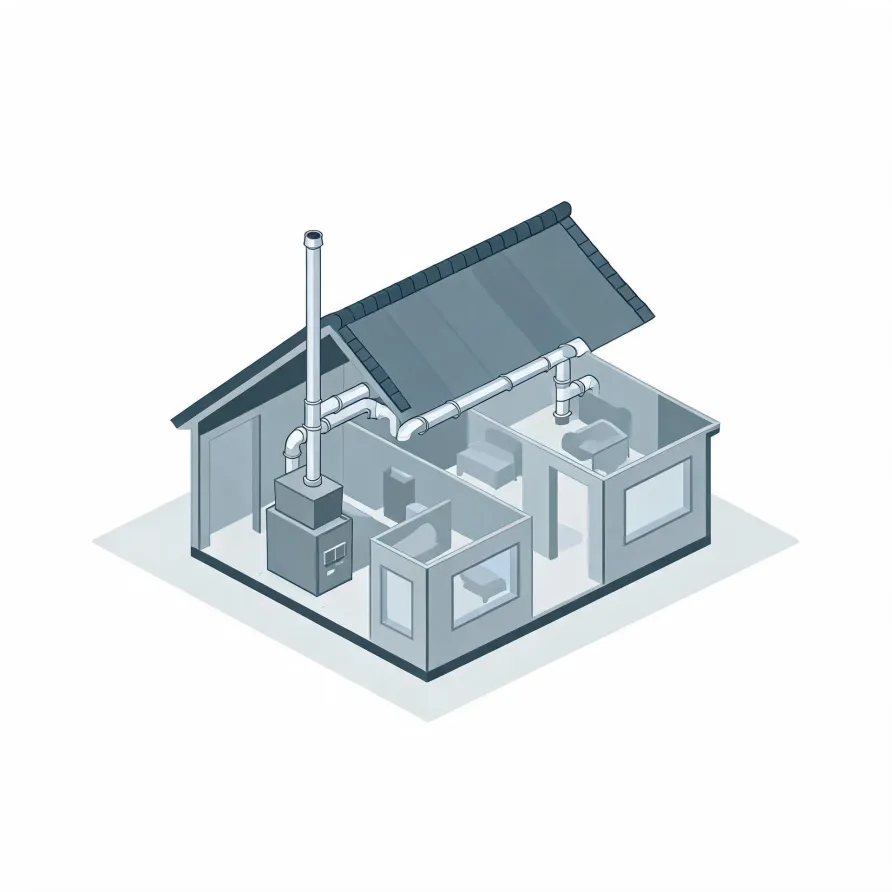
The furnace itself sits in the basement, utility room, or closet and is the piece a contractor examines most closely during a repair call. Inside it, the heat exchanger, burners, and blower motor each have a distinct job, and a fault in any one of them shows up differently. Cracked heat exchangers, worn burners, and failing blower motors are the places a contractor looks first when something is wrong.
The flue pipe runs from the furnace up and out of the house, carrying combustion gases away. Alongside the furnace sits the air handler or blower cabinet, and near it the filter housing, the draft inducer, and the limit and pressure switches that tell the system when something is outside normal operating range. These smaller components are frequent sources of trouble even when the furnace itself is sound.
The drawing shows a typical furnace layout, and a licensed contractor determines which components apply to your specific system and what condition each one is in.
Get matched in Horry CountyHorry County, by the record
211 severe weather events were recorded in Horry County, South Carolina between 2015 and 2024.
NOAA National Centers for Environmental Information, Storm Events Database, bulk CSV export, events 2015-01-01 through 2024-12-31.Half the homes in Horry County, South Carolina were built in 1999 or earlier (2020-2024 ACS 5-year).
U.S. Census Bureau, 2020-2024 American Community Survey 5-Year EstimatesHorry County, South Carolina holds 217,419 housing units (2020-2024 ACS 5-year).
U.S. Census Bureau, 2020-2024 American Community Survey 5-Year EstimatesOwners occupy 77.3% of the occupied homes in Horry County, South Carolina (2020-2024 ACS 5-year).
U.S. Census Bureau, 2020-2024 American Community Survey 5-Year EstimatesFurnace Repair Rules & Codes for Horry County, South Carolina5 sourced rules and standards
What HVAC Repair Looks Like in Horry County
Non-weatherized gas furnaces manufactured on or after November 19, 2015 must reach 80.0 percent AFUE.
Non-weatherized oil-fired furnaces manufactured on or after November 19, 2015 must reach 83.0 percent AFUE.
Mobile home gas furnaces manufactured on or after November 19, 2015 must reach 80.0 percent AFUE.
Non-weatherized gas furnaces manufactured on or after December 18, 2028 must reach 95.0 percent AFUE, up from the 80.0 percent minimum that applies to units manufactured before that date.
Contractor Rules in Horry County, South Carolina
South Carolina requires a mechanical contractor license for contracting work whose total cost of construction is greater than ten thousand dollars.
Severe Weather Events in Horry County
Extreme weather puts a load on furnaces that routine use does not. How hard that load hits depends on what this area actually sees, which is why local weather history belongs in any honest conversation about repair and service needs.
211 severe weather events, 2015–2024. Source: NOAA National Centers for Environmental Information, Storm Events Database.