Tell us about the job
Takes about a minute. No obligation.
The burner and heat exchanger in a furnace cycle on and off through a long heating push each year, and that cycling is where cracks, scale, and ignition faults develop. Homes in Pickens County, SC run heat about seven months a year, from October through April. A contractor called out for a furnace repair in this county starts at those components, because that is where the load lands. Flame sensors foul, heat exchanger surfaces fatigue, and ignition systems fail from repetitive thermal stress. A furnace standing idle through the warmer months can also mask a crack until the first cold call of the season.
Furnace repair in a county where so much of the housing stock is this old runs into a specific problem once the unit is open: parts. Half the homes in Pickens County, South Carolina were built in 1989 or earlier (2020-2024 ACS 5-year). A contractor who pulls a heat exchanger or a control board out of a furnace in a house that age is checking whether that component is still in production before the repair scope is written. When it is, the job is straightforward. When it is not, the contractor is pricing a replacement instead, and the homeowner is making a different decision than they expected.
The Parts of a Furnace a Contractor Checks First
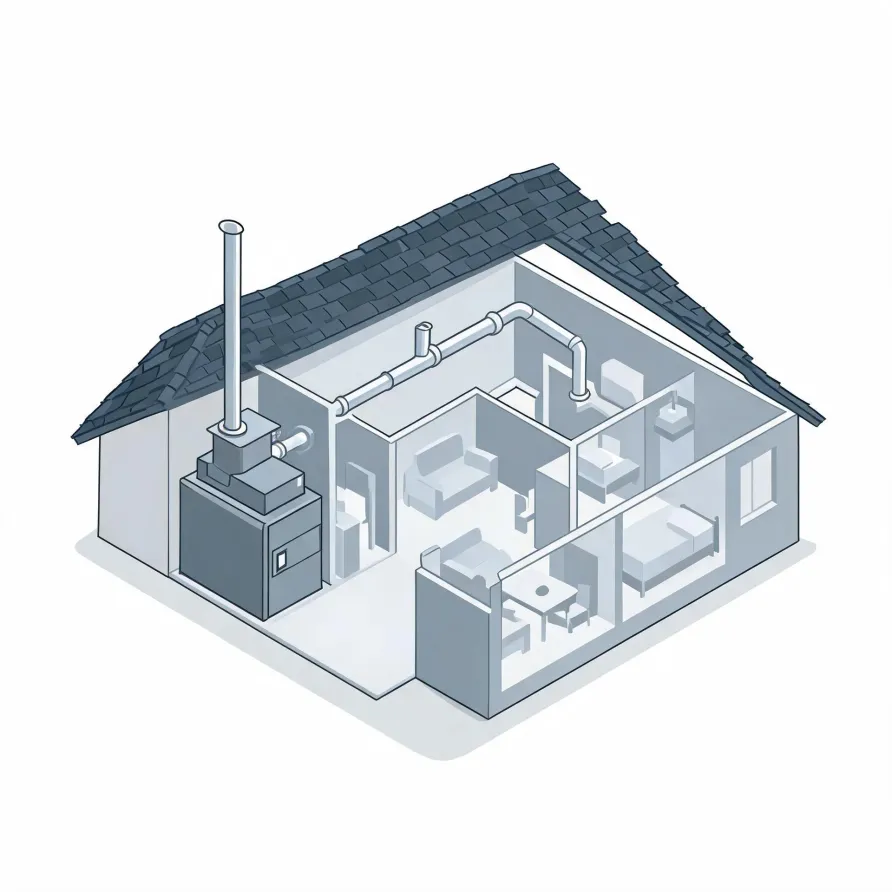
The furnace itself sits in a mechanical room, basement, or utility closet and is the piece a contractor goes to first. Inside it, the heat exchanger is the part that most often explains a heating failure. The burners, the igniter, and the flame sensor all work together to start and sustain combustion, and any one of them can be the reason the system does not fire.
The blower motor and its fan wheel sit inside the furnace cabinet and push conditioned air through the house. The flue pipe runs from the furnace to an exterior vent and handles exhaust. The thermostat on the wall is the control side of the system, and a contractor checks it alongside the mechanical parts because a wiring fault or a failed sensor there can look exactly like a furnace problem.
The drawing shows the general layout of a furnace system, and a licensed contractor determines which components and configurations apply to your specific home.
Get matched in Pickens CountyPickens County, by the numbers
113 severe weather events were recorded in Pickens County, South Carolina between 2015 and 2024.
NOAA National Centers for Environmental Information, Storm Events Database, bulk CSV export, events 2015-01-01 through 2024-12-31.Half the homes in Pickens County, South Carolina were built in 1989 or earlier (2020-2024 ACS 5-year).
U.S. Census Bureau, 2020-2024 American Community Survey 5-Year EstimatesPickens County, South Carolina holds 58,677 housing units (2020-2024 ACS 5-year).
U.S. Census Bureau, 2020-2024 American Community Survey 5-Year EstimatesOwners occupy 70.9% of the occupied homes in Pickens County, South Carolina (2020-2024 ACS 5-year).
U.S. Census Bureau, 2020-2024 American Community Survey 5-Year EstimatesCodes & Standards Governing Furnace Repair in Pickens County, South Carolina5 sourced rules and standards
What the repair visit looks like
Non-weatherized gas furnaces manufactured on or after November 19, 2015 must reach 80.0 percent AFUE.
Non-weatherized oil-fired furnaces manufactured on or after November 19, 2015 must reach 83.0 percent AFUE.
Mobile home gas furnaces manufactured on or after November 19, 2015 must reach 80.0 percent AFUE.
Non-weatherized gas furnaces manufactured on or after December 18, 2028 must reach 95.0 percent AFUE, up from the 80.0 percent minimum that applies to units manufactured before that date.
What Pickens County, South Carolina Requires for HVAC Repair Work
South Carolina requires a mechanical contractor license for contracting work whose total cost of construction is greater than ten thousand dollars.
Severe Weather Events in Pickens County
Pickens County weather puts real stress on heating equipment over time. How often that stress hits shapes how hard a furnace has to work and how quickly that work catches up with it.
113 severe weather events, 2015–2024. Source: NOAA National Centers for Environmental Information, Storm Events Database.