Tell us about the job
Takes about a minute. No obligation.
Homes in Bamberg County, SC run heat about five months a year, from November through March. The burner and ignition system cycle every time the furnace fires, and across a heating season that long, the wear on them accumulates in ways that show up as hard-start faults, uneven heat, or a system that cuts out under load. A contractor quoting a furnace repair in Bamberg County checks the heat exchanger for fatigue and the igniter for degradation before moving to secondary components. Those are where the season's work lands.
Half the homes in Bamberg County, South Carolina were built in 1978 or earlier (2020-2024 ACS 5-year). A furnace that has been running in a house of that vintage has likely outlasted one or two parts already, and when a contractor opens the cabinet, the question is whether what failed can still be ordered or has to be sourced from a dwindling supply chain. Heat exchangers, draft inducers, and control boards for systems of that generation are not always stocked locally. That gap between what the repair calls for and what is readily available is what drives the scope of the job and, in some cases, the conversation about what comes next.
The Parts of a Furnace a Contractor Checks First
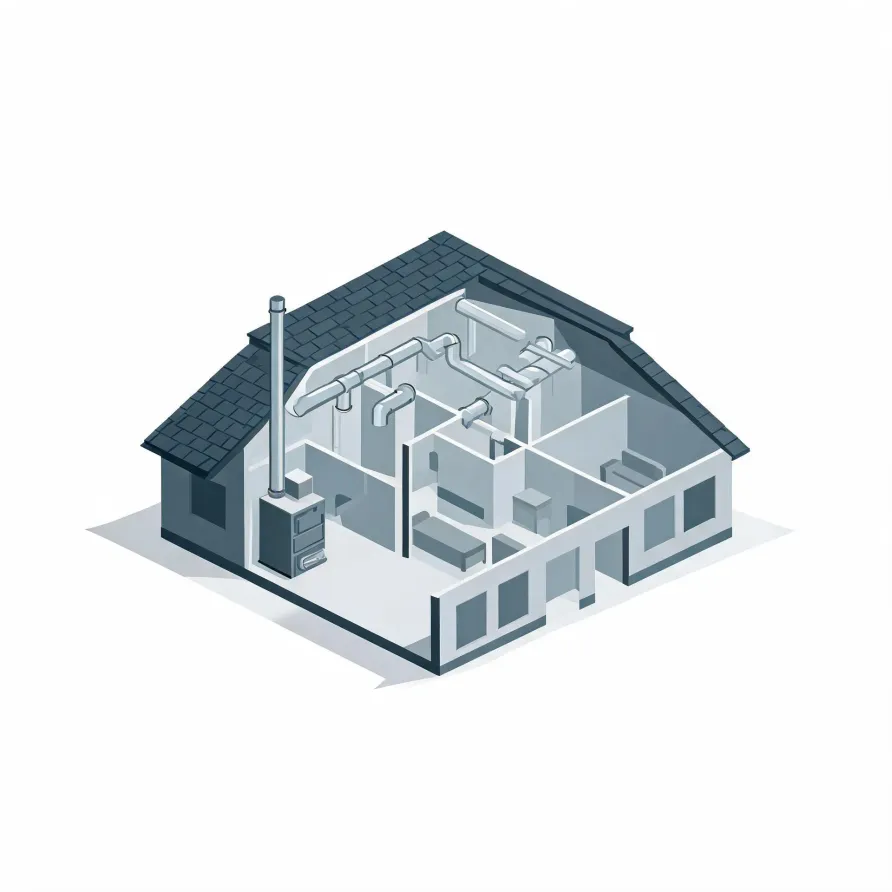
The furnace itself sits in a basement, utility closet, or mechanical room and is the piece a contractor goes to first. Inside it, the heat exchanger, burners, and blower motor each have a distinct job, and a fault in any one of them produces its own recognizable symptom. A cracked heat exchanger, a failed igniter, or a seized blower motor will each stop the system in a different way.
The flue pipe carries combustion gases out of the house and connects the furnace to the outside; a blockage or a breach there shows up as a safety lockout. The thermostat and the control board sit at opposite ends of the signal chain, and when either one misbehaves the furnace may not fire at all, making them early stops in any diagnostic.
The drawing shows a typical furnace layout, and a licensed contractor determines which components apply to the specific system in your home.
Get matched in Bamberg CountyBamberg County, by the numbers
55 severe weather events were recorded in Bamberg County, South Carolina between 2015 and 2024.
NOAA National Centers for Environmental Information, Storm Events Database, bulk CSV export, events 2015-01-01 through 2024-12-31.Half the homes in Bamberg County, South Carolina were built in 1978 or earlier (2020-2024 ACS 5-year).
U.S. Census Bureau, 2020-2024 American Community Survey 5-Year EstimatesBamberg County, South Carolina holds 6,581 housing units (2020-2024 ACS 5-year).
U.S. Census Bureau, 2020-2024 American Community Survey 5-Year EstimatesOwners occupy 70.4% of the occupied homes in Bamberg County, South Carolina (2020-2024 ACS 5-year).
U.S. Census Bureau, 2020-2024 American Community Survey 5-Year EstimatesCodes & Standards Governing Furnace Repair in Bamberg County, South Carolina5 sourced rules and standards
What the repair visit looks like
Non-weatherized gas furnaces manufactured on or after November 19, 2015 must reach 80.0 percent AFUE.
Non-weatherized oil-fired furnaces manufactured on or after November 19, 2015 must reach 83.0 percent AFUE.
Mobile home gas furnaces manufactured on or after November 19, 2015 must reach 80.0 percent AFUE.
Non-weatherized gas furnaces manufactured on or after December 18, 2028 must reach 95.0 percent AFUE, up from the 80.0 percent minimum that applies to units manufactured before that date.
What Bamberg County, South Carolina Requires for This Work
South Carolina requires a mechanical contractor license for contracting work whose total cost of construction is greater than ten thousand dollars.
Severe Weather Events in Bamberg County
Extreme weather puts real stress on heating equipment, pushing furnaces to run harder and longer than steady conditions require. How often that happens in Bamberg County shapes how quickly parts wear and how often repairs come due.
55 severe weather events, 2015–2024. Source: NOAA National Centers for Environmental Information, Storm Events Database.