Tell us about the job
Takes about a minute. No obligation.
Sizing a furnace for this house is not a generic calculation. Homes in Lancaster County, SC run heat about five months a year, from November through March. A unit that is undersized will cycle more often across those months, and the burner and ignition system carry that cost directly. An oversized unit brings its own problem: short cycles that leave the heat exchanger running hotter than it was rated to sustain. A contractor doing a load calculation here has to account for the house's insulation, its ductwork, and its actual heat loss before the equipment goes in, because an install that is wrong at the start runs wrong through every season that follows.
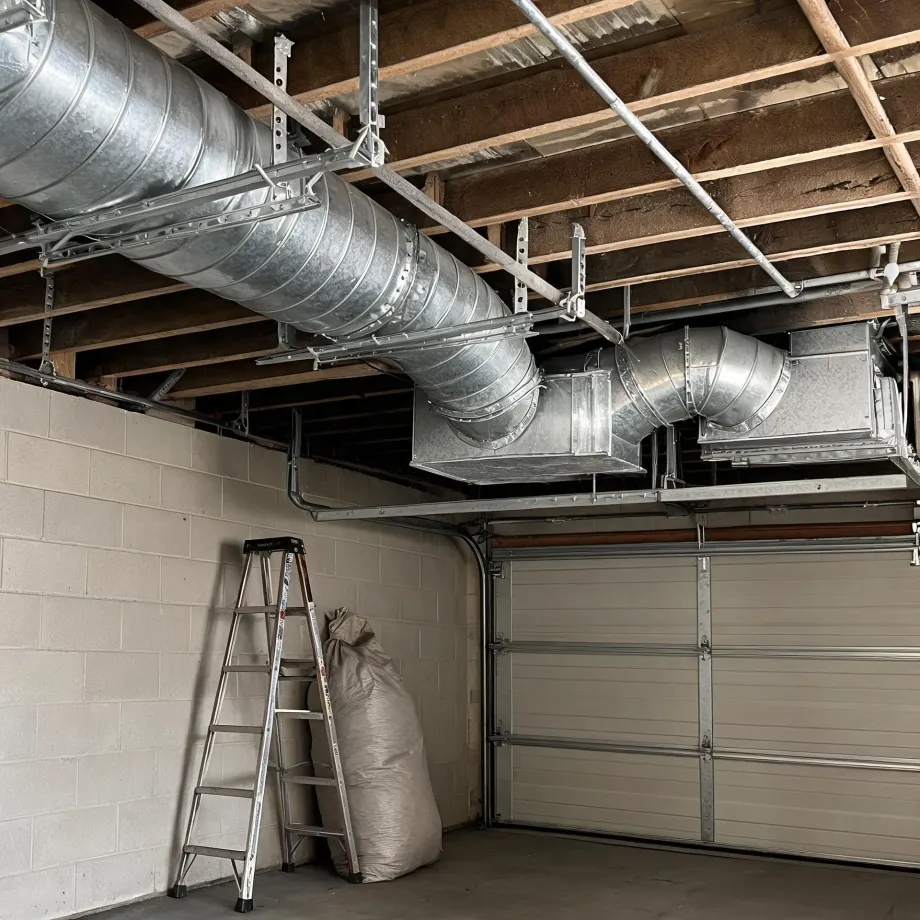
Ductwork sized for a modern forced-air system and service panels wired for current draw are what a contractor finds in a large share of houses here. Half the homes in Lancaster County, South Carolina were built in 2000 or earlier (2020-2024 ACS 5-year). That means the existing infrastructure is not the variable a contractor has to work around before pricing or sizing a furnace. What gets examined is the equipment fit itself, the flue configuration, and where the new unit lands in the space, not whether the house can handle what runs in it.
What Gets Installed With a New Furnace
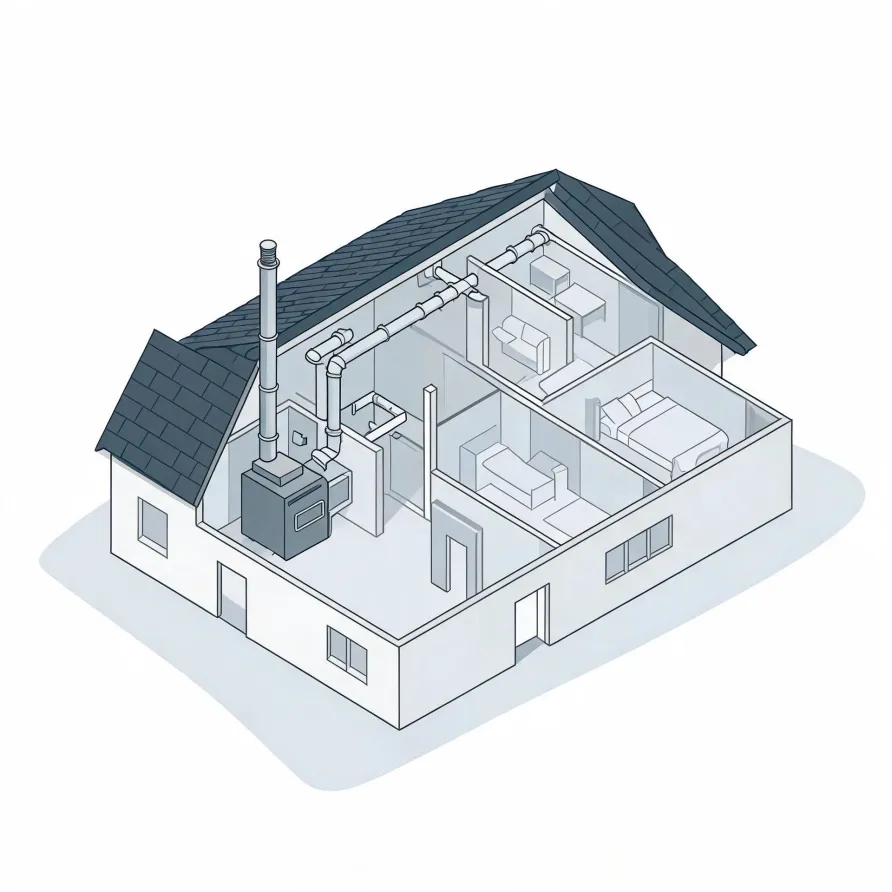
The furnace itself sits inside the house, most often in a basement, utility closet, or mechanical room. It is the unit that generates heat by burning fuel or running electrical elements through a heat exchanger, then pushing that warmed air into the supply side of the home. A flue pipe exits the unit and runs to the outside, carrying combustion gases out of the living space.
The thermostat mounts on an interior wall where it reads the air temperature and signals the furnace to fire or rest. Alongside the furnace, a filter housing holds the air filter that screens particulates before air moves through the heat exchanger. Some installations also include a new air handler or coil cabinet when the home has a paired cooling system sharing the same cabinet.
The drawing shows a typical layout, and a licensed contractor determines exactly which components apply to your house.
Get matched in Lancaster CountyLancaster County, SC, by the numbers
191 severe weather events were recorded in Lancaster County, South Carolina between 2015 and 2024.
NOAA National Centers for Environmental Information, Storm Events Database, bulk CSV export, events 2015-01-01 through 2024-12-31.Half the homes in Lancaster County, South Carolina were built in 2000 or earlier (2020-2024 ACS 5-year).
U.S. Census Bureau, 2020-2024 American Community Survey 5-Year EstimatesLancaster County, South Carolina holds 43,832 housing units (2020-2024 ACS 5-year).
U.S. Census Bureau, 2020-2024 American Community Survey 5-Year EstimatesOwners occupy 83.3% of the occupied homes in Lancaster County, South Carolina (2020-2024 ACS 5-year).
U.S. Census Bureau, 2020-2024 American Community Survey 5-Year EstimatesCodes & Standards Governing Furnace Installation in Lancaster County, South Carolina5 sourced rules and standards
What the installation looks like
Non-weatherized gas furnaces manufactured on or after November 19, 2015 must reach 80.0 percent AFUE.
Non-weatherized oil-fired furnaces manufactured on or after November 19, 2015 must reach 83.0 percent AFUE.
Mobile home gas furnaces manufactured on or after November 19, 2015 must reach 80.0 percent AFUE.
Non-weatherized gas furnaces manufactured on or after December 18, 2028 must reach 95.0 percent AFUE, up from the 80.0 percent minimum that applies to units manufactured before that date.
Contractor Rules in Lancaster County, South Carolina
South Carolina requires a mechanical contractor license for contracting work whose total cost of construction is greater than ten thousand dollars.
Severe Weather in Lancaster County
Weather events put a load on heating and cooling equipment, and Lancaster County's climate shapes what a furnace here has to handle year after year. That makes local weather history part of the conversation about what to install and how to size it.
191 severe weather events, 2015–2024. Source: NOAA National Centers for Environmental Information, Storm Events Database.