Tell us about the job
Takes about a minute. No obligation.
A furnace repair quote in Charleston County starts with the burner assembly and heat exchanger, because those are the components that absorb the full demand each season places on the system. Homes in Charleston County, SC run heat about five months a year, from November through March. The ignition system cycles hard through those months, and the heat exchanger expands and contracts with every call for heat. Cracks and fatigue in the exchanger are what a contractor checks before anything else, because a failed exchanger changes both the safety assessment and the repair scope. The idle period that follows is long enough that a slow developing fault can sit undetected until the first cold night of the next season.
Furnace repair in stock this old runs into a specific problem once the unit is open: the heat exchanger, the burner assembly, and the controls were sized and specified for systems that may have been swapped out once or twice since the house was built. Half the homes in Charleston County, South Carolina were built in 1991 or earlier (2020-2024 ACS 5-year). That gap between the building and whatever is running in it now shows up as wear patterns a contractor has to read component by component, because the part a failed furnace actually needs is not always the part that looks worst from the outside.
The Parts of a Furnace a Contractor Checks First
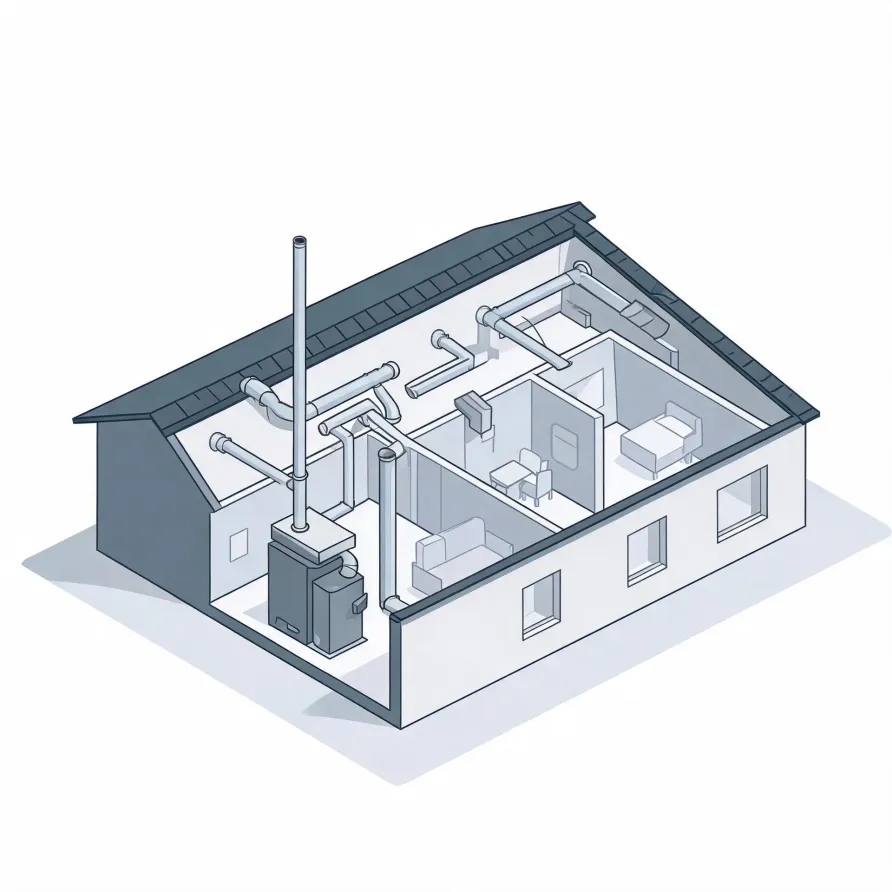
The furnace itself sits in a utility space, basement, or closet and is the piece that generates heat. A contractor starts there, because the heat exchanger inside it, the burners, and the igniter are common sources of failure. When the heat exchanger cracks or the igniter stops firing, the system either produces no heat or shuts itself down on a safety trip.
The blower motor moves conditioned air out of the furnace and into the supply ducts, and it gets close attention because a failing motor is a frequent reason a furnace runs but nothing warm reaches the rooms. The flue pipe runs from the furnace to an exterior vent and carries combustion gases out of the house. The thermostat and the control board sit at opposite ends of the system and handle the signals that tell everything else when to run.
The drawing shows the general layout of a furnace system, and a licensed contractor determines which parts apply and what condition they are in for your specific house.
Get matched in Charleston CountyCharleston County, by the numbers
436 severe weather events were recorded in Charleston County, South Carolina between 2015 and 2024.
NOAA National Centers for Environmental Information, Storm Events Database, bulk CSV export, events 2015-01-01 through 2024-12-31.Half the homes in Charleston County, South Carolina were built in 1991 or earlier (2020-2024 ACS 5-year).
U.S. Census Bureau, 2020-2024 American Community Survey 5-Year EstimatesCharleston County, South Carolina holds 209,803 housing units (2020-2024 ACS 5-year).
U.S. Census Bureau, 2020-2024 American Community Survey 5-Year EstimatesOwners occupy 63.9% of the occupied homes in Charleston County, South Carolina (2020-2024 ACS 5-year).
U.S. Census Bureau, 2020-2024 American Community Survey 5-Year EstimatesRules & Standards Governing Furnace Repair in Charleston County, South Carolina5 sourced rules & standards
What HVAC Repair Looks Like in Charleston County
Non-weatherized gas furnaces manufactured on or after November 19, 2015 must reach 80.0 percent AFUE.
Non-weatherized oil-fired furnaces manufactured on or after November 19, 2015 must reach 83.0 percent AFUE.
Mobile home gas furnaces manufactured on or after November 19, 2015 must reach 80.0 percent AFUE.
Non-weatherized gas furnaces manufactured on or after December 18, 2028 must reach 95.0 percent AFUE, up from the 80.0 percent minimum that applies to units manufactured before that date.
What Charleston County, South Carolina Requires for HVAC Repair
South Carolina requires a mechanical contractor license for contracting work whose total cost of construction is greater than ten thousand dollars.
Severe Weather Events in Charleston County
Extreme weather puts real strain on furnace components, from heat exchangers to ignition systems, as equipment cycles harder and longer to hold indoor temperatures steady. How often that pressure hits depends on what the local climate actually does, which is why that record matters here.
436 severe weather events, 2015–2024. Source: NOAA National Centers for Environmental Information, Storm Events Database.